
Deep Thoughts: On Power in Vans
Alright, let’s talk about power.
We’re going to be going over our Power Panel Ecosystem. Whether you’re getting the DIY kit or one of the kits we install here at Roost Vans, the core idea is the same: bring all your wiring into one central spot so you can control how power gets distributed throughout your van.
Think of Your Battery as a Cup
Let me break it down. Imagine your battery as a cup of water. That’s your power capacity. Filling that cup? That’s your recharge. Draining the cup, those are your power loads. And the size of the cup, that’s the size of your battery.
You typically have three recharge sources:
- The Sun (solar)
- Your Engine (while you’re driving)
- Shore Power (when you’re plugged in)
Of those, your engine and shore power give you the biggest juice. Solar? Honestly, solar tends to be the third-best option. It’s restricted by clouds, roof space, and price per watt. And if you’ve got a vent fan or roof box up there, your solar footprint shrinks quick.
But if you’re parking somewhere for five days and not driving? That’s when solar becomes your best friend. So it really depends on your trip style.
Power Needs: Big Draw vs. Small Draw
Here’s what I ask clients:
- What are you powering?
- How are you recharging it?
If you’re running big power draws, like an A/C unit, induction cooktop, hair dryer, or even a blender, we’ve got to plan around that. Even your fridge, which seems simple, is a constant draw making it important to get a quality fridge.
So, increase the battery size, or make sure it’s getting refilled. Often times it’s the Air Conditioner that is the big culprit. And in order to really accommodate that sufficiently. You are likely looking to invest about $10k to $15k apples to apples, specifically for the ability to power an Air Conditioner off grid for 8-12 hours. So, we suggest to our typical customers to wire the Air Conditioner in a way that it can be powered off of shore power. Then, if you know you are going somewhere hot, find a campground to plug into or bring a quiet Honda generator with you.
Smaller draws include:
- LED lighting
- Vent fan
- Heater (that uses a fuel tap)
- Water pump
- Laptop
Most folks fall into that smaller-draw category. Very few actually need the big battery setups they think they do.
Personally, I like a 200 amp-hour battery (~2400 watts). It’s the sweet spot in the camper van, out for a couple days use case. It’s just enough capacity, can recharge from the engine, shore power, and solar if needed. Add a couple of solar panels, and you’re looking at a solid 3-day or longer camping rig for most people.
Also worth noting: most of us are parking in the shade. So again, solar might not pull the weight you want unless you’re strategic.
The Power Panel Kit: What It Is
Let’s look at the actual Power Panel Kit:
- Power Panel itself which contains:
- Distribution block to powers 12V systems (lights, fans, etc.)
- Inputs for shore power, solar, and engine power
- Connections for the Roost EZ Connect Cable
- Jumper Cable
- Switch Plate (on a 6ft leads from the Power Panel)
- 3 light dimmers
- 3 auxiliary switches
- DC outlet with dual USB port insert
- Location for Espar Easy Start Pro thermostat placement (not included)
The Jumper Cable allows you to power your loads straight from your engine battery if you remove your power station. Say you take it inside for charging? No problem. Just don’t forget to turn your lights off unless you want a dead starter.

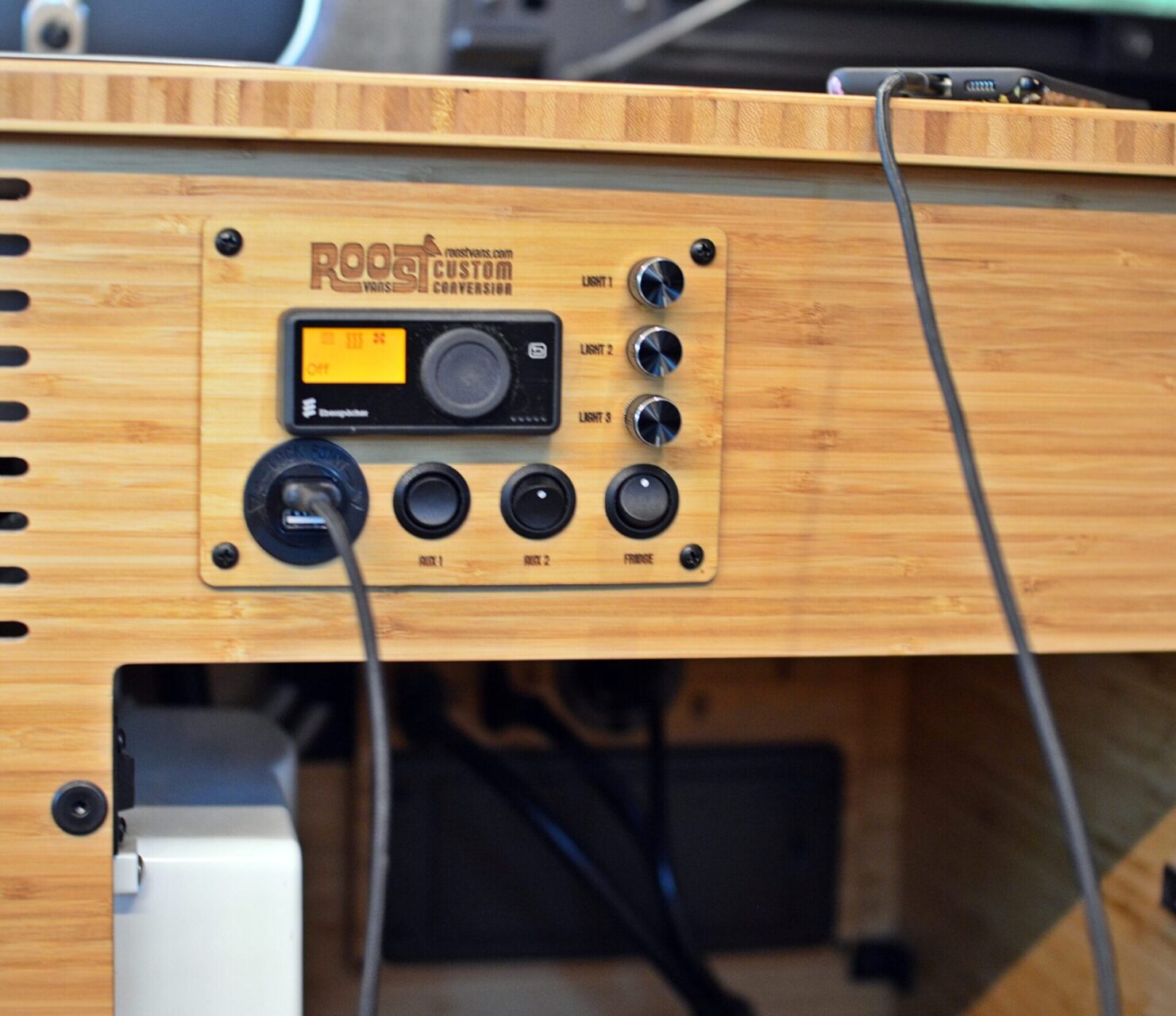
Accessories Available:
- Highly Recommended > Charge Lines and Installation Kit: all your lines (solar, shore, ground, engine), ties, protectors, sleeves, sealants, and clips
- Goal Zero EZ Connect wiring harness (for the X-series). Our first choice
- Bare End EZ Connect wiring harness that connects your choice of power station ↔ power station. You will need to crimp and engineer this yourself
- AC Outlet Extension (household power extension)
We tried to think of everything so your install goes smooth.
Real-World Install Example
We dropped a Goal Zero 1000X in a cabinet with the link module and the easy-connect harness. You can see the power panel snugged right against the wall, clean and tight. From there, you bring in all your loads (lights, fans, etc.) to the distribution block on the power panel.
And when you’re ready for cabinetry, you can mount the switch panel to the front, passenger side, driver side, wherever works best. That’s the flexibility we built in.
Plus, there’s a 120V inlet option as part of our AC Outlet Extension Accessory that can be wired in the wall. You can plug an extension cord from your inverter into that inlet, which feeds power through to another outlet you can install in the van. Don’t need it? No problem. But if you want it, it’s a readily available accessory.
A Clean Solution for Real Life
In one of our recent builds, we installed the power panel behind a Goal Zero 6000X. All the wiring and switches are right there. Want dimmable lighting? Easy. Want to hide the main panel but have access for maintenance? Done.
We use a cigarette-style plug for USB-B/C or whatever the current tech is. That’s by design. Technology changes, and we want you to be able to pull the USB plug and upgrade without a total overhaul.

Final Thoughts
The Power Panel Ecosystem is built to simplify van wiring. You still have some work involved, this isn’t magic. But the lions share is done. It pulls everything into one spot, gives you switch control, and offers a clean, expandable, and future-proof way to handle power in your van.
And, it’s available now on our website.